Before you sign a 12-month IT software contract, check six things besides the price. Find the auto-renewal clause and its notice deadline. Compare the seat count with real usage. Look for a cap on renewal price increases. Read the exit and data-export terms. Confirm what is billable. Then set a reminder early enough to act. Get each one in writing before you sign.
What should I check before signing a 12-month IT software contract?
Check how the contract renews, what you pay for, and how you get out. Price is only one line.
Most problems with a 12-month contract show up in month 11. That’s when the contract renews by itself, you find you’ve paid for seats nobody used, or the notice window closed weeks ago. Before signing, go through this list:
- Renewal clause. Does it renew automatically? For how long, and at what price?
- Notice period and method. How many days’ notice does the vendor need, in what form, and sent to which address?
- Billable unit. Is it users, technicians, devices or modules? How does the count change during the term?
- Seat count. Does the number you commit to match how many people actually use the tool?
- Price protection. Is there a cap on increases at renewal?
- Exit terms. Can you export your data, in what format, within what window? Will the vendor confirm it has been deleted?
- Feature stability. Can the vendor take features out of your plan during the term?
- Owner and reminder. Who in your team owns this contract, and when does their reminder go off?
Which notice dates and auto-renewal terms matter most?
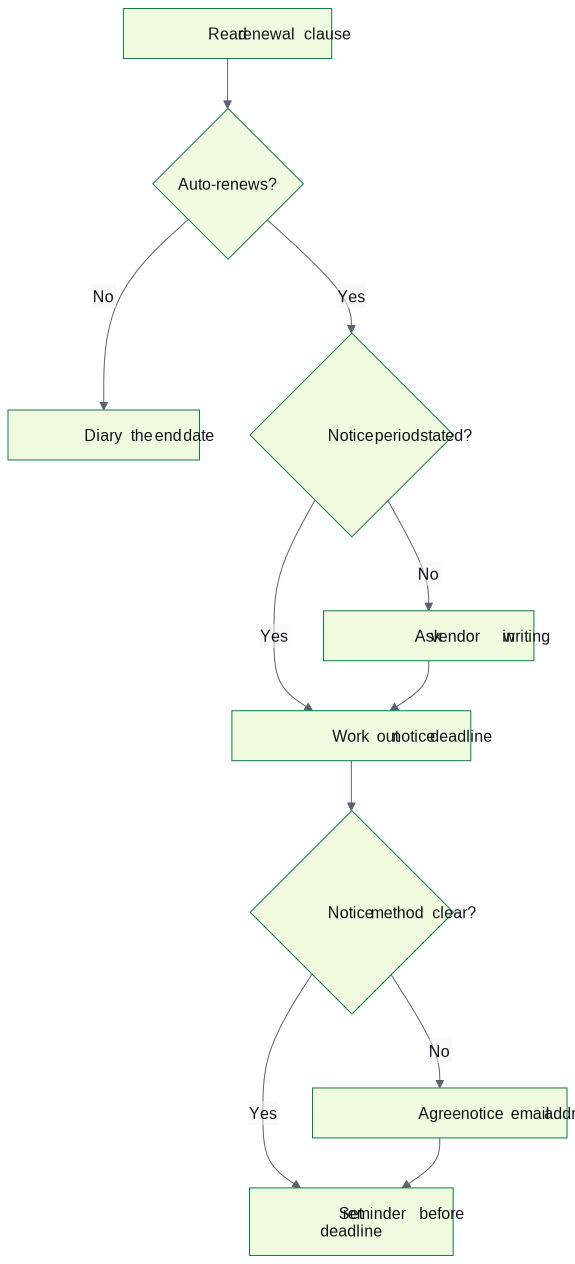
The date that matters most is the notice deadline: the renewal date minus the notice period. After that day, you’re committed to another term.
A contract that renews on 1 October with 60 days’ notice has to be cancelled by about 2 August. Teams that track only the renewal date miss this regularly. Look for these terms:
- Renewal length. “Renews for successive 12-month terms” locks you in for another year. Monthly renewal after the first term is much easier to manage.
- Notice form. Some contracts require written notice to a legal address. Ask for a named email address to be accepted, and write it into the contract.
- Renewal price. If the clause says renewal is “at then-current list price”, you have no price protection.
- Local law. Some places regulate business-to-business auto-renewal. New York’s General Obligations Law § 5-903 is one example. It is designed to protect businesspersons who find themselves “married” to self-renewing maintenance or service contracts, and it does not apply where the automatic renewal period is one month or less. Don’t plan around a law like this protecting you. Plan around your own reminder.
How do I confirm the seat count matches real usage?
Compare the seats in the quote with the people who actually used the tool in the last 30 to 60 days, not with your headcount.
Seat waste is common. According to Zylo’s 2026 SaaS Management Index, nearly 46% of SaaS licenses go unused in any 30-day period. Before you commit:
- Get last-used dates. Export them from the vendor’s admin console, or from your own register if the tool is already in place.
- Remove leavers and duplicates. Former staff, contractors whose work ended, and people with two accounts all inflate the count.
- Define a seat. Is it a named user, a concurrent user, a technician or a device? A per-technician price and a per-device price can’t be compared until you convert them.
- Check the true-up and true-down rules. Ask whether you can add seats mid-term at the same unit price, and whether you can reduce seats at renewal. Many contracts allow only the first.
- Look for minimum commitments. A floor of 100 seats is a fixed cost, whatever you use.
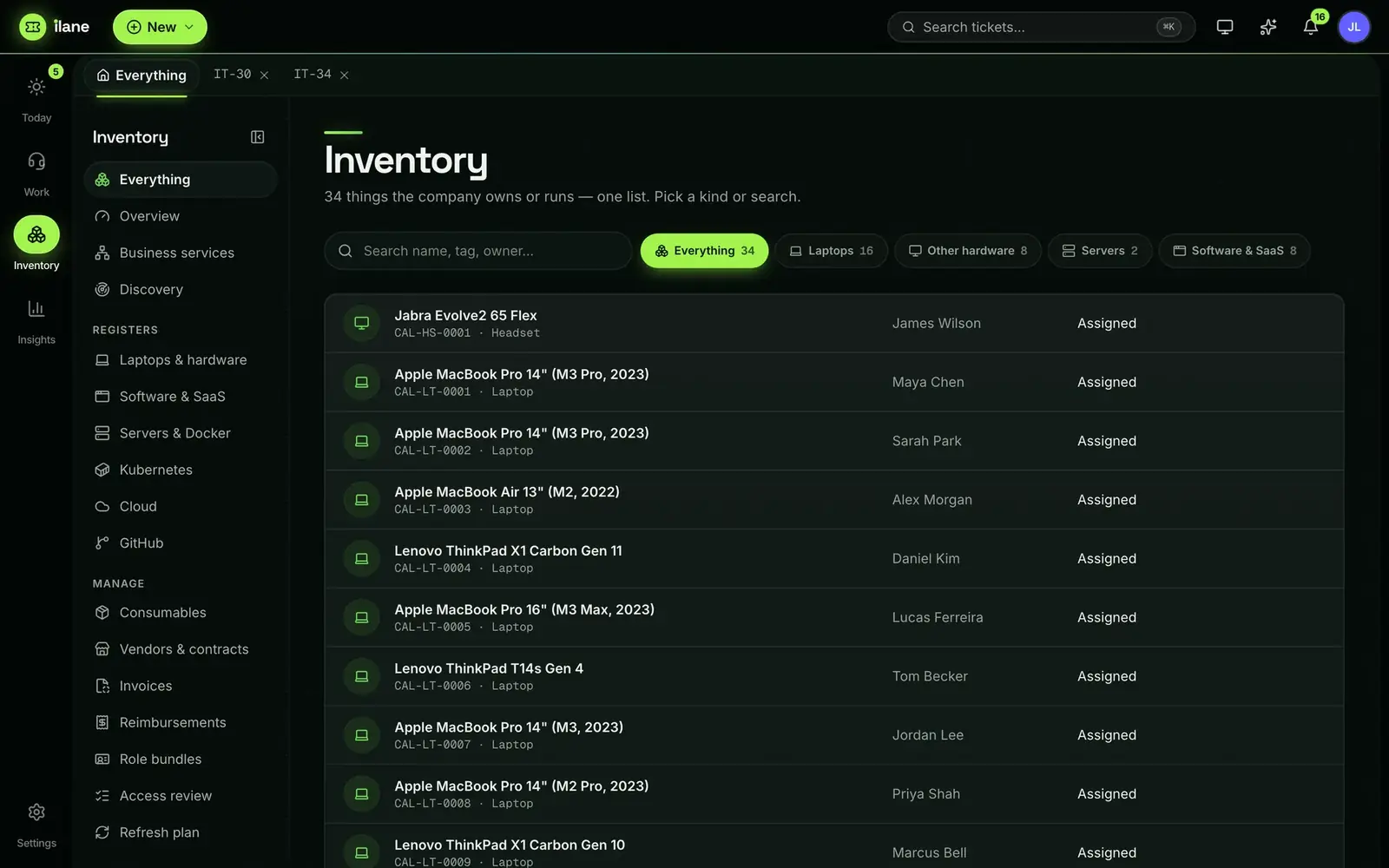
ilane’s assets and licences register shows seats that haven’t been used in months and lets you take them back in one step. It also flags paid apps someone installed without a licence. Our guide to finding and reclaiming unused SaaS licences covers the full process, including flagging seats that have been idle for 60 days.
What exit, data export and termination terms should I ask for?
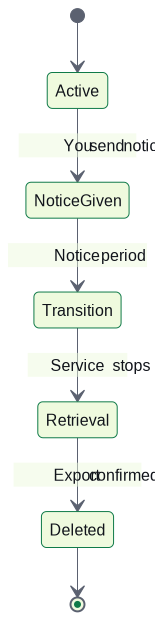
Ask for three things: a right to export all your data in a usable format, a set window to do it, and written confirmation that the data has been deleted afterwards.
What to put in the contract:
- Export format and scope. Ask for tickets, assets, audit logs and attachments in CSV or JSON, not just a PDF report.
- Export window. Get a stated number of days after termination during which you can still get to your data.
- Deletion. If the vendor processes personal data for you, GDPR already covers this. The UK regulator explains that under Article 28(3)(g) the contract must say that at the end of the contract the processor must, at the controller’s choice, delete or return all the personal data (ICO guidance).
- Switching rights in the EU. The EU Data Act sets minimum terms for cloud services. Under it, the notice period for initiating the switching process cannot exceed two months, and until 12 January 2027, providers may still charge reduced switching charges, limited to the costs directly incurred (DLA Piper). Contracts must also allow a transition phase of no more than 30 calendar days; data retrieval must be possible for at least 30 days thereafter (Digital Chiefs).
- Feature changes. Ask for a clause that stops the vendor cutting core features during a paid term. ilane’s own terms say it will not materially reduce the core features of a paid plan during its term without notice, and that the customer owns its data.
- Termination for cause. If the vendor repeatedly misses its service levels, you should be able to leave without paying for the rest of the term.
Which price terms should I compare beyond the headline rate?
Work out the total yearly cost per device or per user for the modules you’ll actually use, with renewal increases included. Then compare quotes on that number.
| Term | What to ask | Why it matters |
|---|---|---|
| Billing metric | Per user, per technician or per device? | Growth affects each one differently |
| Renewal cap | Is there a maximum % increase at renewal? | Without a cap, renewal is at list price |
| Tiers and add-ons | Which features are top tier only? | Problem and change management, AI and compliance are often extras |
| Minimums and true-ups | Floor commitment? Can you reduce at renewal? | Unused seats become a fixed cost |
| One-off fees | Onboarding, migration, training | These add to the first-year cost |
| Payment terms | Annual upfront or quarterly? | Affects cash flow, and what you lose if you leave early |
| Hosting | Cloud only, or self-hosted too? | Data residency and exit options |
Ask for the renewal cap before you sign the first contract. Gartner’s advice is to negotiate price protection so renewal prices cannot rise by more than 3% (nominal) to 5% (maximum). For multiyear renewals, it says to make sure this is a one-time increase across the total renewal term, not an annual one.
For reference, ilane quotes each team based on how many laptops, desktops and servers run the ilane agent. It can be self-hosted with Docker Compose or run as a dedicated hosted instance. You can also start with a pilot on one team and keep everything you set up when you move to a full plan.
How do I set a renewal reminder early enough to decide?
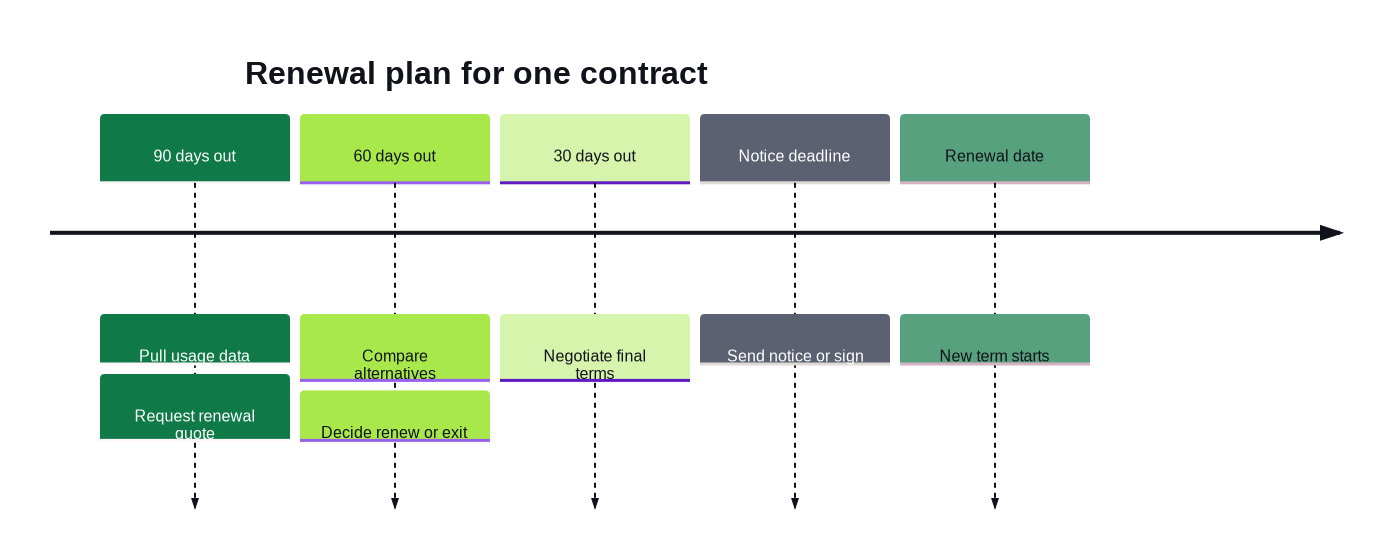
Set the reminder from the notice deadline, not the renewal date. Leave at least one full review cycle before it, and give the reminder to a named owner.
A reminder that fires a week before the deadline only lets you renew. To actually choose, you need time to pull usage data, get a competing quote and negotiate. A workable plan for one contract:
Make each reminder something someone has to act on, not a calendar alert people can dismiss. In ilane, the vendors and contracts register stores contracts with their notice dates, and renewals come with a reminder ticket early enough to decide. That reminder has an owner and appears in the queue like any other piece of work. The hardware and software docs explain how seats, costs and renewals are tracked.
What should I bring to a vendor demo to test the contract claims?
Bring your current contract, a usage export and the quote. Then ask the vendor to show each claim working live, rather than describing it.
What to bring and what to ask for:
- Your device and user counts. Ask them to price that exact number of seats or devices on the call.
- Your current quote. Compare it line by line: modules, tiers, add-ons and the renewal cap.
- An export test. Ask them to export a sample of tickets and assets and show you the file.
- The cancellation path. Ask where the renewal date and notice period appear in the product and in the contract.
- One real problem. Have them fix one issue on a real or demo laptop and show how the tool confirms the fix worked.
ilane’s comparison page invites you to bring your current quote so it can be compared line by line, and says that if the other suite wins, ilane will tell you. The demo is a 30-minute call. It runs on a demo company or on one of your laptops, and ends with fixing one thing together and watching ilane check the fix is real.
Before you sign
A 12-month IT software contract is easy to sign and easy to renew without noticing. Before you sign, write down the notice deadline, check the seat count against real usage, get a renewal cap, and confirm you can export your data and have it deleted. Then give the renewal to one owner, with a reminder that leaves time to decide.
Book a demo → Bring your quote and your device count, and we’ll go through both on a 30-minute call.
Frequently asked questions
Is an auto-renewal clause enforceable in a B2B software contract?
Usually, yes. Businesses are generally expected to read their contracts, so an auto-renewal clause normally holds. Some places add conditions. New York’s General Obligations Law § 5-903, for example, covers self-renewing service contracts between businesses. Don’t count on a statute to get you out. Track the notice deadline yourself.
What happens if I miss the notice deadline?
In most contracts you’re committed to another full term, often at the vendor’s list price at that point. Ask the vendor anyway: some will agree to a shorter extension or fewer seats rather than lose the account. Then set the next reminder from the notice deadline, not the renewal date.
Should I sign a multi-year contract for a bigger discount?
Only if you’re confident about usage and the contract caps renewal increases, lets you reduce seats, and lets you export your data at any point. A discount that comes with no exit rights and no renewal cap can cost more over three years than a 12-month contract you can renegotiate.
How far ahead should I start reviewing a renewal?
Start about 90 days before the notice deadline. That leaves time to pull usage data, get a competing quote and negotiate before you’re locked in. For large or hard-to-replace tools, start earlier.